Meat and Poultry
The Baking Powder Secret to Extra-Crisp Chicken Skin
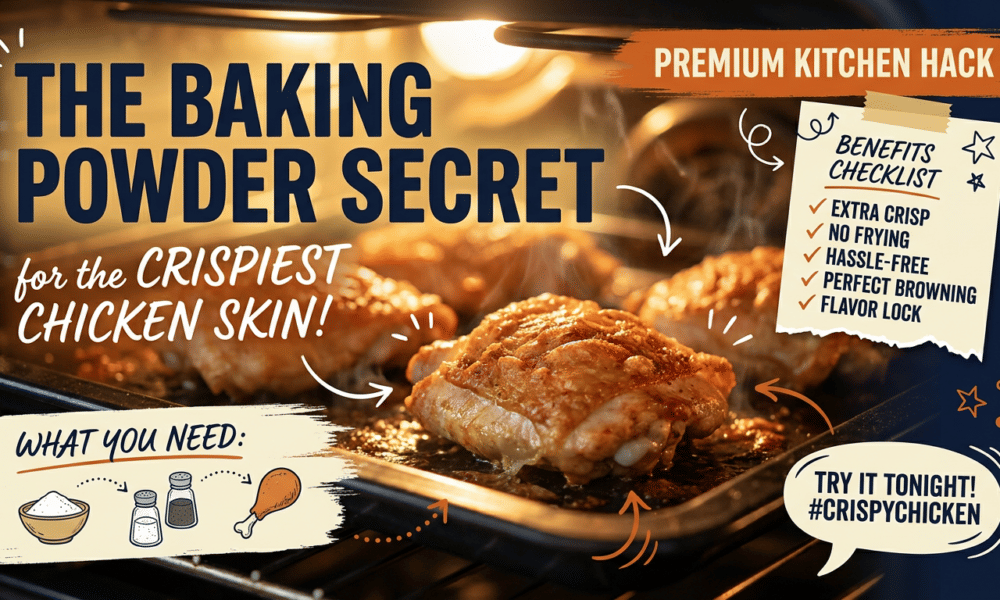
One pantry staple, zero extra effort, and the crispiest roast chicken skin you’ve ever pulled from your oven — here’s the science and the technique behind the trick that professional chefs don’t advertise.
Let me tell you about the first time I tried the baking powder trick. I was skeptical in that particular way you get skeptical when something sounds too simple — like someone’s about to tell you the secret to a perfect soufflé is just “believe in yourself.” Baking powder on chicken skin? That’s a leavening agent. That’s for cakes. That’s the thing you accidentally leave out of muffins and spend twenty minutes Googling why they turned out like hockey pucks.
And yet. I dusted my chicken thighs, left them uncovered in the fridge overnight, pulled them out the next evening, and roasted them at 425°F. What came out of that oven had skin so shatteringly crisp, so audibly crackling, so deeply golden that I stood at the counter eating pieces of it like potato chips before the chicken even made it to the plate.
I’ve been doing it ever since. And once I understood why it works, I started doing it with even more conviction.
The Problem With Chicken Skin (And Why Most Solutions Miss the Point)
Here’s the fundamental challenge: chicken skin is essentially a thin membrane of fat and collagen sandwiched between two protein layers. Getting it crispy requires driving out moisture fast enough that the surface dehydrates and browns before the fat underneath renders completely and turns everything greasy and soft.
Most approaches attack this problem from the outside in. Pat it dry. Crank up the oven. Blast it under the broiler at the end. All of these work, to varying degrees — but they’re all fighting the moisture problem reactively, trying to evaporate water that’s already there when the heat hits.
Baking powder attacks the problem proactively, at the chemical level, before the oven is even preheated. That’s what makes it different. That’s what makes it feel almost like cheating.
What Baking Powder Actually Does to Chicken Skin
Two things happen when baking powder meets chicken skin, and both of them are working in your favor simultaneously.
First: it raises the pH. Baking powder is alkaline — it increases the surface pH of the skin, which accelerates the Maillard reaction (the same browning chemistry responsible for the crust on your steak, the color on your bread, the deep gold on those pan-roasted thighs we’ve talked about before). Higher pH means faster, more aggressive browning at lower temperatures. Your chicken gets darker, richer color without having to push the oven temperature into dangerous territory.
Second: it draws out moisture and creates tiny bubbles. As the baking powder reacts with the moisture in the skin during its rest in the refrigerator, it pulls liquid to the surface — where it evaporates into the cold, dry refrigerator air. The skin dehydrates. But it doesn’t just dehydrate uniformly — the reaction creates microscopic bubbles in the skin’s surface, like a thousand tiny craters. When heat hits those bubbles, they expand and set, creating a dramatically increased surface area. More surface area means more crunch per square inch. It’s the difference between a flat cracker and a puffed one — same ingredients, completely different texture.
The result is skin that’s lighter, crispier, and more evenly colored than anything you’d get from drying alone.
The Ratio That Actually Works
Here’s where the internet gets loose with the facts. Some recipes call for a teaspoon per pound. Others go more conservative. After considerable experimentation — some triumphant, some instructively terrible — the ratio I keep returning to is three-quarters of a teaspoon of baking powder per pound of chicken, mixed with one teaspoon of kosher salt.
Go heavier and you start tasting the baking powder — a faint metallic, slightly soapy note that has no business being on a roast chicken. Go lighter and the effect is there but muted, like the difference between whispering and speaking clearly.
Mix the baking powder and salt together first before applying. The two need to work together — the salt draws moisture to the surface, the baking powder does its chemical work on that moisture. They’re a team. Don’t add them separately.
One more thing: use aluminum-free baking powder. Regular baking powder contains sodium aluminum sulfate, which can contribute a metallic flavor that’s subtle but real. Aluminum-free versions (Bob’s Red Mill makes a widely available one) deliver all the same textural benefits without any off-notes. It’s a small detail that makes a meaningful difference.
The Technique, Step by Step
The method is almost insultingly simple, which is part of what makes it so satisfying once you see the results.
Prep the chicken. Pat it completely dry with paper towels — aggressively, obsessively dry. The baking powder works best on a surface that isn’t already pooling with moisture.
Mix and apply. Combine your baking powder and kosher salt in a small bowl. Sprinkle it over the skin side of the chicken — thighs, breasts, drumsticks, a whole spatchcocked bird, whatever you’re working with — and use your fingers to distribute it evenly, getting into the crevices and folds where the skin bunches up.
Refrigerate uncovered. This is the step that separates the technique from a last-minute pantry trick. Set the chicken on a wire rack over a baking sheet and leave it in the refrigerator — uncovered — for a minimum of one hour, though overnight is categorically better. The refrigerator’s dry, circulating air pulls the surface moisture out. The baking powder reacts with what’s there. You come back the next day to chicken that looks almost papery on the surface, slightly tacky, noticeably drier than when it went in. That’s exactly what you want.
Roast at high heat. Pull the chicken from the fridge 30 minutes before cooking to take the chill off. Roast at 425°F — the high heat works with the baking powder’s pH-raised skin to produce browning that’s fast, even, and deeply colored without tipping into burnt. Don’t cover it. Don’t baste it. Let the chemistry do its work.
Whole Birds vs. Pieces: Does It Matter?
The technique works across the board, but there are a few nuances worth knowing.
Bone-in pieces — thighs, drumsticks, split breasts — are the easiest application. The skin is relatively flat, easy to coat evenly, and the shorter cooking time means the baking powder effect is concentrated and dramatic.
Whole birds benefit enormously, particularly if you spatchcock them first. A spatchcocked bird has more skin exposed to direct oven heat, and the baking powder treatment on a full bird left overnight produces genuinely extraordinary results — the kind of whole roast chicken that makes people fall silent for a moment when they see it come out of the oven.
Wings are where this trick becomes almost unfair. Chicken wings treated with baking powder and roasted in a hot oven produce a skin so thin, so crackling, so impossibly crisp that they’re genuinely indistinguishable from deep-fried wings in texture — without a drop of oil. This is the application that converts the last remaining skeptics. Make them once and you’ll never coat wings in sauce before baking again.
What It Won’t Do
Let’s be honest with ourselves, because a technique that sounds this good deserves realistic expectations.
Baking powder transforms the skin. It does not transform the meat underneath. Badly seasoned chicken with great skin is still badly seasoned chicken with great skin. The interior still needs dry-salting, still needs proper cook temperature, still needs to rest before carving.
Think of the baking powder trick as the finishing layer on a well-built house — it makes everything look spectacular on the outside, but the structure underneath still has to be sound. Use it in combination with everything else you know about cooking good chicken, not as a substitute for it.
Also: it won’t rescue wet chicken. If you skip the refrigerator rest, you lose most of the benefit. The rest isn’t optional. It’s where the chemistry actually happens. An hour minimum, overnight maximum reward.
The Pantry Secret That Isn’t Really a Secret
Here’s the funny thing about the baking powder trick: it’s been in food science literature for years, quietly doing its thing in the background while the rest of the internet argued about brining and oven temperatures. It’s not proprietary knowledge. It’s not a restaurant trade secret. It’s literally a box in your baking cabinet that costs two dollars and has been there the whole time.
Sometimes the best cooking techniques aren’t the ones requiring the most obscure ingredients or the most elaborate equipment. Sometimes they’re the ones hiding in plain sight, waiting for someone to connect the dots between a chemistry principle and a Wednesday night chicken dinner.
Now you’ve got the dots connected. Go dust some chicken.
Frequently Asked Questions
Does baking powder make chicken taste different? When used in the correct ratio — three-quarters of a teaspoon per pound — and with aluminum-free baking powder, there’s no detectable flavor difference. Go heavier and you risk a faint metallic note. Stick to the ratio and the only thing you’ll notice is better texture.
Can I use baking soda instead of baking powder? Technically yes, but with important caveats. Baking soda is about three to four times more potent than baking powder, so you’d use a fraction of the amount — roughly a quarter teaspoon per pound. The risk of over-application and off-flavors is significantly higher with baking soda. Baking powder is the more forgiving, more controllable choice.
Does this work on chicken that’s already been marinated? Unfortunately, no. Marinades — especially acidic ones — introduce moisture and compete with the dehydrating effect you’re trying to create. The baking powder technique works best on dry, clean chicken skin. Choose one or the other.
How long can I leave the chicken in the fridge after applying baking powder? Up to 24 hours is the sweet spot. Beyond that, the skin can become overly dry and the texture changes in ways that aren’t improvements. Overnight — eight to twelve hours — produces the best results consistently.
Can I add other seasonings along with the baking powder mixture? Absolutely — with one caveat. Avoid sugar-containing spice rubs or anything with high moisture content. Dry spices like garlic powder, smoked paprika, and black pepper mix beautifully with the baking powder and salt blend and go on at the same time without interfering with the technique.