Meat and Poultry
The Searing Myth: Why Browning Doesn’t Actually “Seal in Juices”
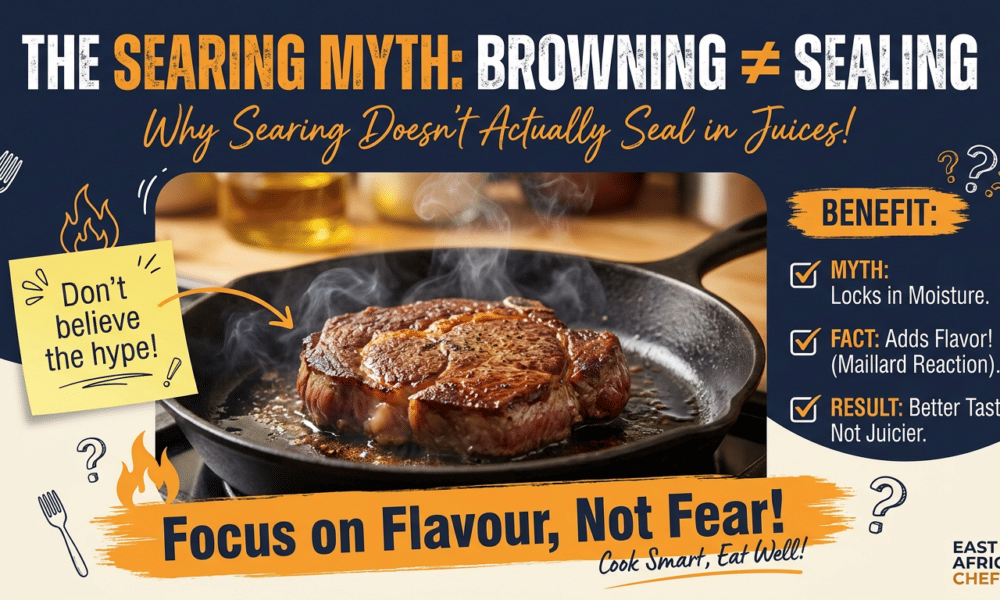
The most repeated piece of cooking wisdom is also one of the most scientifically wrong — here’s what searing actually does, why it still matters enormously, and how understanding the truth makes you a better cook.
There’s a particular kind of confidence that comes from cooking advice you’ve never questioned. You heard it early, it sounded scientific, and it fit neatly into the story you were already telling yourself about why food tastes good. Searing meat seals in the juices. Of course it does. The heat closes the pores, forms a crust, locks everything inside. It just makes sense.
Except it doesn’t. And it never did. And the man who originally said it — a 19th-century German chemist named Justus von Liebig, who had strong opinions about meat science and was spectacularly wrong about this particular one — has been quietly debunked for over a hundred years while the rest of us kept repeating his mistake at dinner parties.
Welcome to the most persistent myth in cooking. Pull up a chair. This is going to reframe everything you thought you knew about why you sear.
The Origin Story of a Beautiful Lie
Justus von Liebig wasn’t a bad scientist. He made genuine contributions to chemistry and nutrition that are still referenced today. But in 1847, he published a theory about meat cookery that sounded so logical, so mechanically satisfying, that it spread through culinary culture like a grease fire.
His claim: searing meat at high heat cauterizes the surface, creating an impermeable crust that physically traps moisture inside. The juices, unable to escape through the sealed exterior, stay locked in the meat throughout cooking.
It’s a seductive idea. It has the ring of physics to it — cause and effect, action and consequence, heat doing something solid and protective. Escoffier picked it up. Brillat-Savarin gestured toward it. Generations of cooking teachers repeated it as settled fact. By the time Harold McGee came along in 1984 and politely, methodically, scientifically dismantled it in On Food and Cooking, the myth had been running for nearly 140 years and had accumulated the kind of cultural momentum that facts alone struggle to stop.
What Actually Happens When You Sear Meat
Here’s the experiment that proves Liebig wrong, and it’s almost insultingly simple. Sear two identical pieces of chicken. Weigh them before and after cooking. Both pieces lose moisture — measurably, consistently, regardless of whether they were seared first or not. The seared piece doesn’t retain more juice than the unseared one.
In fact — and this is the part that really lands — if you sear at high enough heat for long enough, the seared piece sometimes loses more moisture than the unseared one, because the aggressive surface heat drives moisture out faster.
The crust doesn’t seal anything. Meat isn’t a balloon. There are no pores to close — or rather, meat has a porous, fibrous structure that no amount of surface heat actually makes impermeable. Moisture escapes through a seared crust the same way it escapes through an unseared one: as steam, through the protein matrix, driven by heat. The “seal” is a fiction.
So why does seared chicken taste so much better than unseared chicken? Genuinely, empirically, obviously better — because it does, and no amount of mythbusting changes the fact that a properly seared piece of meat is a fundamentally superior eating experience.
That’s where the real story starts.
Meet the Maillard Reaction: The Actual Hero
Here’s the concept that deserves all the credit that “sealing in juices” has been hoarding. The Maillard reaction is a chemical process that occurs when amino acids and reducing sugars on the surface of food are exposed to heat above roughly 280°F. At that temperature, they don’t just brown — they transform, creating hundreds of entirely new flavor compounds that exist nowhere in the raw ingredient.
We’re talking about compounds with names like furans, pyrazines, and thiophenes — the molecules responsible for the complex, roasted, savory depth that makes a seared chicken thigh taste like a completely different food than a poached one. Not just darker. Not just crunchier. Fundamentally different in flavor at the molecular level.
This is why searing matters. Not because it builds a wall. Because it builds a library — an enormous catalogue of flavor complexity that you simply cannot achieve any other way. The crust on properly browned chicken isn’t a seal. It’s a flavor factory that ran a full shift before the oven even got involved.
And here’s the part that changes how you cook: once you understand that browning is about flavor creation rather than moisture retention, you stop treating it as a preliminary step and start treating it as the point. You sear longer. You sear hotter. You wait for that deep mahogany color instead of pulling the chicken off at “golden.” Because you now know that every extra thirty seconds of aggressive browning is thirty more seconds of flavor compounds being built.
The Moisture Question, Honestly Answered
Okay — if searing doesn’t retain moisture, what actually does?
Several things, it turns out, and none of them involve creating an impermeable crust.
Muscle fiber behavior under heat. When chicken cooks, the muscle fibers contract and squeeze liquid toward the center of the meat. The rate of that contraction is directly related to temperature and time. Slow, moderate heat lets the fibers contract gradually. Aggressive, prolonged high heat makes them contract violently and squeeze out significantly more moisture. This is why a chicken breast cooked gently to 160°F is juicier than one cooked hard to 180°F — not because of any crust, but because of how the internal temperature was reached.
The rest period. Here’s where the actual “sealing in juices” happens, somewhat ironically — not at the sear, but at the end. When you pull chicken from heat and let it rest, the contracted muscle fibers gradually relax and the liquid redistributes back through the meat. The juices don’t stay put because of a crust. They stay put because you gave the proteins time to stop wringing themselves out.
Dry-salting. Remember our conversation about salt disrupting protein structure? That’s moisture retention in action — the salt actually modifies the proteins’ ability to contract during cooking, meaning they squeeze out less liquid even under high heat. This is the closest thing to actual moisture retention that exists in the home cook’s toolkit, and it happens twelve hours before the pan gets hot, not during the sear.
Why the Myth Persists (And Why It Matters That It Does)
Here’s what I find genuinely fascinating about the sealing myth: it’s been disproven repeatedly, publicly, by credible food scientists for decades, and it persists anyway. Why?
Partly because it feels true. You sear chicken, you eat chicken, the chicken is juicy. Post hoc reasoning fills in the gap: the searing must have worked. The actual causes — proper temperature management, resting, good technique throughout — are less visible and less satisfying as a story.
Partly because the advice to sear is still correct even when the reason is wrong. If your cooking teacher tells you to sear your chicken because it seals in the juices, and you sear your chicken, and your chicken is delicious — the wrong explanation produced the right behavior. The myth is self-reinforcing because it’s attached to good advice even though the underlying science is fiction.
But here’s why the truth actually matters, practically: if you believe searing seals in juices, you’ll treat the sear as the critical moisture-retention step and everything else as secondary. You might skip the rest (“the juices are sealed in, they’ll stay there”). You might pull the bird at the wrong temperature because you think the crust is handling moisture management. You might skip dry-salting because you’re confident the sear has everything covered.
Understanding what searing actually does — and what actually retains moisture — means every part of your cooking process gets the right level of attention. You sear aggressively for flavor. You manage temperature carefully for moisture. You rest religiously for redistribution. You salt in advance for protein modification. Each step does its real job instead of all of them deferring to a crust that was never doing what anyone thought it was doing.
The Practical Upshot
None of this means you should change whether you sear. You should absolutely sear. The Maillard reaction is real, it’s spectacular, and it’s the difference between chicken that’s merely cooked and chicken that’s genuinely, memorably delicious.
What changes is how you sear. You sear for color and flavor, not for a seal. You go hotter and longer than you might have, chasing deep mahogany rather than pale gold. You don’t panic if moisture appears on the surface during searing — that’s just steam, it was always going to be there, the crust isn’t failing at a job it was never doing.
And then — this is the part the myth always made unnecessary — you pay the same careful attention to temperature, resting, and seasoning that you would have paid anyway, because now you know those are the variables that actually determine whether your chicken stays juicy.
Liebig was wrong. The crust is not a seal.
It’s something better: a flavor event. A chemical transformation. A few minutes of heat doing something irreversible and magnificent to the surface of your food.
That’s worth doing for its own sake. No mythology required.
Frequently Asked Questions
If searing doesn’t seal in juices, why does seared meat taste juicier than unseared? It usually doesn’t — controlled experiments show similar moisture loss between seared and unseared meat cooked to the same internal temperature. What searing does is add so much flavor complexity through the Maillard reaction that the overall eating experience feels richer and more satisfying. Flavor perception influences how we experience texture and moisture. A deeply flavored piece of chicken simply tastes juicier, even when the moisture content is comparable.
Does the order of searing matter — sear first or sear last? This is the reverse-sear debate, and it’s a legitimate one. The traditional approach — sear first, finish in the oven — works well and is the more intuitive sequence. The reverse sear — gentle oven first, aggressive sear at the end — produces a slightly more evenly cooked interior with the same quality of crust. Both methods produce the same Maillard reaction. The reverse sear gives you more control over internal temperature; the traditional sear is faster and more practical for weeknight cooking.
Does the myth apply to all meats, or just chicken? All meats. The Maillard reaction and the sealing myth apply equally to beef, pork, lamb, and fish. Harold McGee’s original debunking used beef as the primary example. The moisture retention principles — proper temperature, resting, pre-salting — apply across the board with minor adjustments for fat content and target temperature.
What temperature should I sear chicken at for maximum Maillard reaction? The Maillard reaction accelerates significantly above 300°F surface temperature, which means your pan needs to be substantially hotter than that to account for the cooling effect of the meat. A cast iron skillet preheated over medium-high heat for three to four minutes — hot enough that a drop of water skitters and evaporates immediately — is the right starting point. The surface of properly dry chicken hitting that pan should brown visibly within sixty to ninety seconds.
Should I pat chicken dry before searing if the crust isn’t sealing anything? More than ever, actually. Drying the surface isn’t about helping the seal form — it’s about removing surface moisture that would otherwise need to evaporate before the surface temperature can rise high enough for the Maillard reaction to occur. Wet chicken steams before it browns. Dry chicken browns immediately. The goal is flavor, and dry surface gets you there faster.